In the extraordinary world of the nightclub, there is one figure who commands the attention of the entire dance floor. That figure is the GOGO dancer.
NIGHT OUT THEORY is a new series exploring the culture of nightlife through the perspective of writer and active GOGO dancer Honoka Yamazaki. In this first instalment, she takes us behind the scenes of a profession that, despite its glamorous image, remains surprisingly misunderstood.

GOGO dancers may appear effortlessly glamorous under the lights, but behind the spectacle lies a side of the profession few people ever see. What is life really like in the world of a GOGO dancer? This first chapter offers an inside look.
The Origins and Identity of the GOGO Dancer

The term “GOGO” traces its origins to Whisky a Go Go, the legendary Los Angeles nightclub that rose to prominence in the 1960s. Named after the then-popular expression “go-go,” meaning energetic or full of momentum, the club became famous for the women who danced inside cages suspended from the ceiling, a style widely regarded as the origin of GOGO dancing.
In Japan, the culture evolved through the disco boom of the 1970s and ‘80s before taking on its own distinctive form in the 1990s. At discos such as Juliana’s Tokyo, one of the defining venues of Japan’s late bubble-era nightlife, women danced atop raised platforms while waving large fans known as juri-sen. Although the stars of these venues were ordinary clubgoers rather than professional performers, many of the visual hallmarks of today’s GOGO dancers took shape during this period: elevated platforms, revealing costumes, and energetic performances designed to ignite the dance floor.
In 2000, the dance team CYBERJAPAN DANCERS was formed, helping establish the role of the GOGO dancer within Japan’s club scene. Today, GOGO dancers are widely recognised for energising the crowd at nightclubs and music festivals, but the role is often misunderstood and confused with that of backup dancers or show dancers.
One of the biggest distinctions is that GOGO dancers perform without choreography. Every movement is improvised, responding in real time to the music, the crowd, and the atmosphere on the dance floor. The guests are always the main attraction, while GOGO dancers exist to elevate the energy of the room, acting as a catalyst that brings the entire dance floor to life.
From Being Seen to Commanding the Room

My own journey as a GOGO dancer began when I worked as a backup dancer for a drag queen. Through that connection, I was invited to events within the gay scene, where GOGO culture had already taken root. From there, I gradually expanded my work into lesbian events and eventually mainstream club events.
Some people might wonder, “Why choose to reveal so much of yourself and dance in front of others?” It’s true that the industry has a side where dancers can be treated as commodities. In larger clubs especially, it’s not uncommon for performers to be cast based on factors such as age, height, and body type. From the outside, these realities may be seen as forms of objectification or even sexual exploitation.
However, what I’ve come to realise through my own experience on the floor is that GOGO dancers aren’t simply there to be consumed. They are performers who help create the space itself. Fulfilling the image a venue seeks is not about being reduced to a role; it is part of the professionalism required to bring that venue’s unique world to life.

More than anything, what I believe is important is that dancers shouldn’t be forced into a single mould. With so many different types of GOGO dancers, each person has the right to choose the place where they can express their own individuality to the fullest. In many ways, it’s like the process of a job seeker choosing a company that matches their strengths and values, then carving out their path on their own terms.
Being a GOGO dancer is also about learning how to command a space with nothing but your own body. The moment you step onto the stage and into the spotlight, you transform from someone being watched into someone who controls the energy of the floor. A single movement can shift the attention of hundreds of people and bring the entire room to life. Experiencing that moment so intensely, and feeling its impact in real time, is one of the greatest joys of this profession.
Nightlife Etiquette for the Seasoned Guest

When enjoying a GOGO dancer’s performance, there are two things you can’t overlook: etiquette and tipping culture. The first and most important rule is simple: touching the dancers is strictly prohibited. The same applies to photography. Taking inappropriate photos, such as deliberately focusing on intimate areas, not only takes away from the dignity of the space but can instantly change the atmosphere in a way that experienced guests know to avoid.
Tipping is deeply rooted in club culture and is one of the pleasures of nightlife. A tip isn’t simply an exchange of money. It’s a gesture of appreciation that says, “I value your performance,” and a form of communication that connects the stage with the floor.
For those who want to tip in a more thoughtful way, here’s the proper approach. In most cases, tips are given using ¥1,000 notes. Fold the note lengthwise into thirds or quarters so it is easy for the dancer to receive. A crumpled bill can be difficult to place into a costume, so preparing it in a shape that’s easy to handle is best practice.
There is no set rule for when to give a tip, but the moment you make eye contact with a dancer is usually the easiest opportunity. If the dancer reaches out, place it into their hand. If not, it can be carefully placed somewhere accessible, such as the edge of their costume. The important thing is to never make direct contact with their skin.
Of course, how a performance resonates with you is a personal experience. But if a dancer creates a moment that genuinely moves you, consider showing your appreciation through this gesture. A tip is more than just a payment; it’s part of the refined pleasure of enjoying nightlife as a seasoned guest.
Night Side Glossary

Finally, let’s take a look at some of the terms you’ll hear in the scene. Knowing these words will give you a deeper understanding of the nightlife world.
Clear Heels / Thigh-High Boots
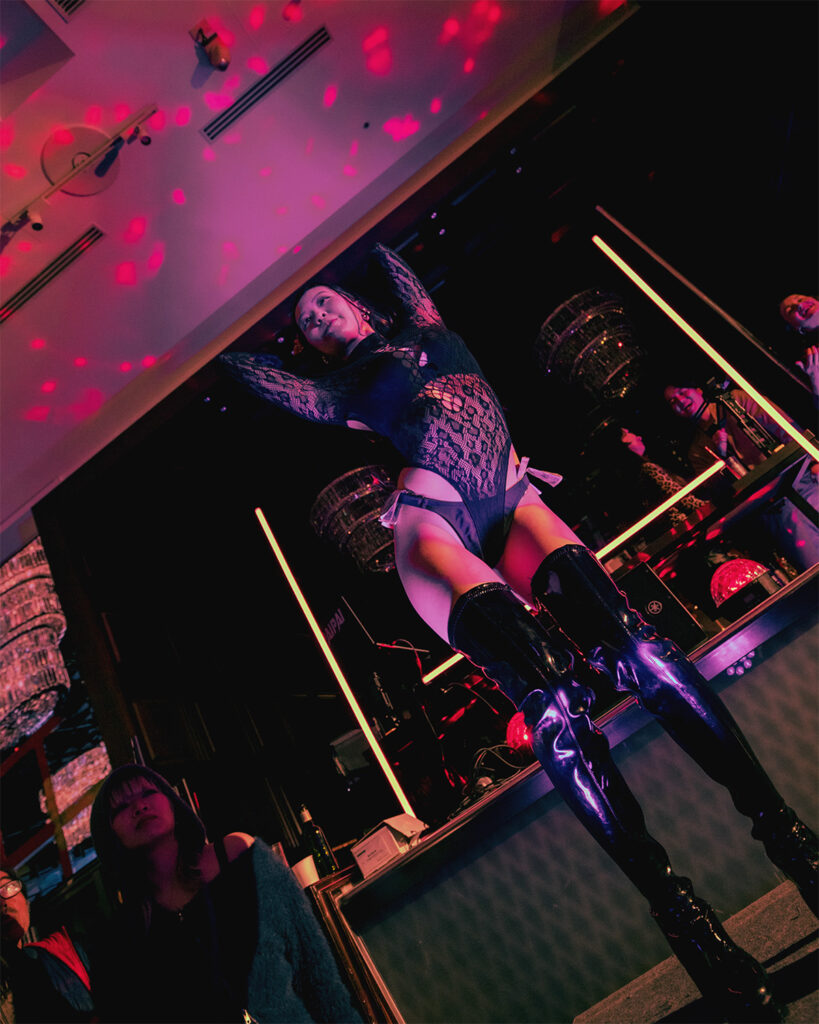
The right pair of heels is an essential part of a GOGO dancer’s look, helping make the legs appear as long and elegant as possible. Depending on the costume and style of the performance, dancers usually choose between clear heels and thigh-high boots.
Clear heels are transparent, creating a seamless line between the shoe and the leg that helps make the lower legs look longer. On the other hand, glossy thigh-high boots that extend up to the thighs create a stronger, more powerful presence.
Both styles are usually 16cm or higher, but they are often designed with thick platforms and sturdy heels to make performances more stable and easier to move in.
Kamite (Stage Right) / Shimote (Stage Left)
In stage terminology, the right side when viewed from the audience is called kamite, and the left side is called shimote. While GOGO dancers may look like they’re moving freely and purely on instinct, they’re constantly aware of these positions, using them to keep the stage balanced and direct the attention of everyone on the floor.
Bamiri (Stage Markings)
Bamiri are small markers that help dancers know where to stand on stage. With darkness, smoke, and intense lighting often filling the space during a performance, dancers rely on small pieces of tape placed on the floor to maintain their positioning and formations.
Otachidai (Raised Platform)
An otachidai is a raised platform set up on the dance floor specifically for performers. The term is closely tied to Japan’s 1990s disco boom, but these raised stages are still commonly seen in today’s nightlife scene.

So, what did you think of this glimpse into the world of nightlife through the eyes of a GOGO dancer? The insights I’ve shared here are only a small part of what I’ve experienced firsthand. But by understanding the world behind GOGO dancers, along with the history and unwritten rules that shape the culture, you may begin to see the nightclub scene from a different perspective, with familiar sights revealing a deeper layer.